
The Growing Case for Alberta Statehood

“Trump made Carney's turnaround victory possible” proclaimed the BBC as it echoed mainstream media. Coverage of last week’s election quickly called out Donald Trump’s relentless antagonizing of Canada—calling it our 51st state and Trudeau its governor—for undermining the previously Trump-adjacent Poilievre. But a closer look at Canada’s electoral map suggests greater and unreported fractures from Trump’s attacks.
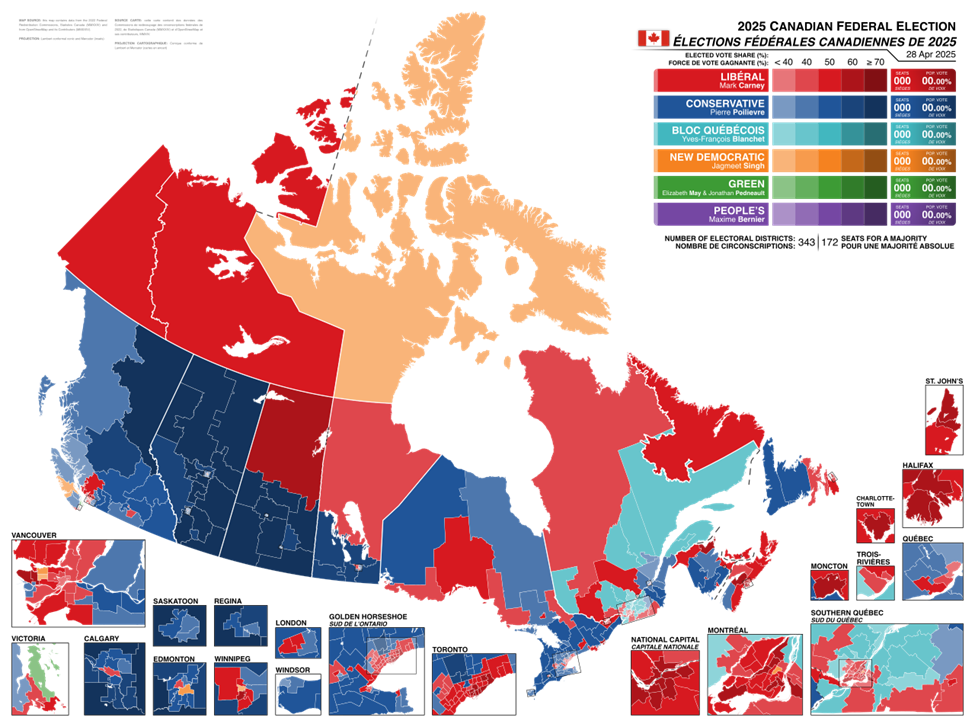
Despite voting overwhelmingly conservative, the provinces of Alberta and Saskatchewan now face four more years of a Liberal-run and potentially anti-fossil-fuels federal government.
Before the elections, gun-loving Alberta was already considered the most American of Canada’s provinces, with 20% to 25% of Albertans saying they are open to joining the U.S., compared to the 10% of Canadians who felt the same way. With the Liberal Party winning another federal election, the share of Albertans seeking independence is now up from 25% to 30%, and in the neighboring province of Saskatchewan, from 20% to 33%.
If you’re wondering why President Trump would even be interested in Alberta, the answer is—unsurprisingly—oil. Alberta, sometimes called “Canada’s Texas,” has more than three times as much oil as the United States. Most of these reserves are buried under easily extractable oil sands, while the U.S. increasingly resorts to fracking to extract the last drops of its crude. The cost to produce one barrel of oil in Alberta is $25 compared to the United States’ $39 per barrel.
It is these natural resources that are so often under attack from Ottawa progressives, fueling an ever-growing divide between a conservative, oil-rich West and a liberal, environmentalist East. The rift between Canada’s East and West has waxed and waned, but a recent tax on fossil fuels may have caused irreparable damage. While the carbon tax has since been removed, the threat of its return looms over the economies of oil-rich provinces and is enough to sustain a movement for more autonomy and governance.
Governance is especially a problem in the Senate. Unlike the United States, senatorial elections are largely symbolic in Canada, as senators are instead appointed at the discretion of the Prime Minister, who has occasionally gone against the will of Albertans and nominated liberal technocrats.
Misrepresentation threatens the oil provinces when Liberals, NDP, and Green Party environmentalists unite in their opposition to fossil fuels. Or as one Albertan told The Spectator, “Our votes in Alberta don’t matter at all. It’s fucking bullshit. And the east hates us but seems to love our money.” The Liberal Party’s environmental goals have certainly not calmed tensions since, as Canada's priorities increasingly clash with Alberta's.
As the Canadian economy heads towards zero emissions by 2050, Trump’s “Drill baby drill!” leads some to believe the province has a brighter future within the United States. If allowed to more freely exploit its own resources, the sky is the limit for Alberta’s future growth.
While America is incentivized to stoke the fires of secession, the barriers to Alberta and Saskatchewan statehood are monumental. It’s not clear that even the most conservative Albertans would renounce free health care in favor of Medicare and Medicaid, nor is it clear what should be done with regard to provincial bureaucracy and First Nations.
Despite the score of new problems, Alberta and Saskatchewan statehood would solve older and more entrenched problems south of the border. The two best candidates for statehood until now, Washington D.C and Puerto Rico, have found virtually no support from Republicans, with Mitch McConnell bluntly stating, “that would give [Democrats] two new Democratic senators, … As long as I’m the majority leader of the Senate none of that stuff is going anywhere.” However, both U.S territories have almost identical population numbers to their Canadian counterparts, which could result in a roughly equal number of new Democratic and Republican seats in the House and the Senate.
It's also worth noting that Calgary, Alberta’s largest city, is roughly the size of Philadelphia, and Edmonton has more people than San Francisco and Boston put together. The GDP per capita of these Canadian cities is 40% greater than the Canadian average, which gives separatists hope for economic prosperity once unshackled from the rest of the country. If Alberta were a state, it would be economically on par with Colorado and the demographic equivalent of Kentucky. If Alberta were a country, its GDP per capita would rank it somewhere between Switzerland and Australia.
For the Trump administration, this begins to look like a no-brainer. Give the Democrats something they have been demanding for decades, and in exchange, add 400% to your oil reserves and grow your GDP without ceding any majority in Congress. It would be one of the most impressive political moves since the Louisiana purchase—a legacy that Trump wouldn’t refuse. But Canadians are not blind to this risk.
On paper, the Liberal Party is no longer run by the Trudeau-ideologues who once shunned Canada’s oil, and removing the carbon tax was one of Marc Carney’s first moves as Prime Minister. But the new and more moderate Liberal majority is fragile. It rests on the support of either Bloc Québécois MPs, who promised to side with Liberals so long as they don’t build an Alberta oil pipeline, or the anti-fossil-fuels NDP and Green MPs.
As Canada’s political landscape continues to shift, a grassroots secession movement is re-emerging on the national stage. Alberta’s Premier Danielle Smith is now fanning the flames of independence with a new bill concerning referendums. Perhaps feeling that the tides are rising, or the winds changing, Premier Smith silently advanced bill 54, reducing the number of signatures required to trigger referendums to 177,000—below the 192,000 signatures garnered by previous independence petitions.
For now, these are mostly threats from an underappreciated and sometimes betrayed province. We are still quite far from actual independence. But if Ottawa and progressive political alliances ignore the growing sense of betrayal among Albertans, they could inadvertently fuel its growing independence movement. The unlikely construction of an Alberta oil pipeline and a US-Canada trade war could further push Alberta into the arms of an eager Trump administration.
As the world’s most powerful and accomplished bully, Trump knows how to apply pressure where it hurts. He knows that if Alberta secedes, Saskatchewan would follow, which would in turn embolden Quebecois separatists and tear the country apart. Canada will do anything to avoid this, but a trade war and fragile political alliances leave its fate up in the air.